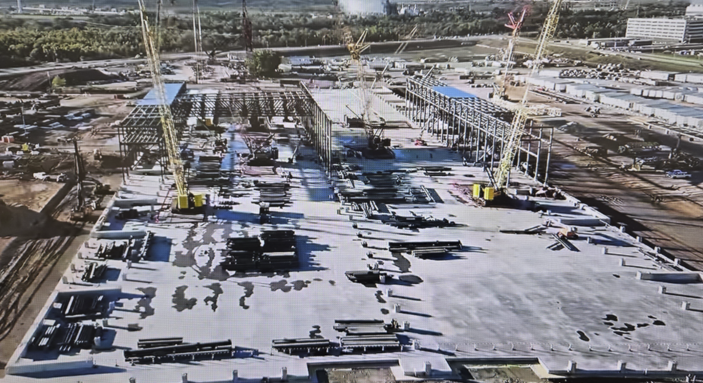
Recently, a friend in Texas sent me aerial photographs of the Terafab construction site.
According to current plans, the smaller facility visible in the photographs is intended to serve as a pilot production and R&D line. Equipment installation is expected to begin around February 2027, with trial chip production targeted for July 2027.
Based on the photographs, construction is still in its early stages. Most of what can be seen today consists of foundation work and portions of the steel framework.
If the company is able to move from the current state of construction to actual semiconductor production by July of next year, that would represent an extraordinarily aggressive schedule by industry standards.
Nearby, construction has already begun on what many consider the real project: the main Terafab manufacturing campus.
Reference video:
The Real Story Is the Scale
The pilot line is interesting.
The main fab is astonishing.
Current plans suggest that Terafab is not being designed as a single-purpose facility.
Instead, the vision appears to include:
- Logic chips
- Memory chips
- Advanced packaging
- Integrated manufacturing ecosystems
within one massive production complex.
If completed according to plan, production could begin around 2028.
This is not simply another semiconductor fab.
It represents an attempt to create a next-generation manufacturing hub at a scale rarely seen in the industry’s history.
The Bigger Problem: Equipment
Most people assume that once the buildings are complete, production naturally follows.
Semiconductor manufacturing does not work that way.
The building is often the easy part.
The difficult part is filling it with equipment.
A modern fab requires thousands of tools:
- Lithography systems
- Etch tools
- Deposition tools
- CMP tools
- Metrology systems
- Packaging equipment
The challenge is that many suppliers are still receiving planning forecasts rather than confirmed purchase orders.
And this creates an interesting chain reaction.
Forecasts Create More Forecasts
A potential fab operator tells equipment suppliers:
“We expect we may need this many tools.”
The equipment supplier then tells component vendors:
“We may need this many subsystems.”
The subsystem vendors then talk to their own suppliers.
The result looks something like this:
Expected Chip Demand
↓
Expected Equipment Demand
↓
Expected Component Demand
↓
Expected Raw Material Demand
Every link in the chain is working from estimates.
Not from actual orders.
The Incentive to Overestimate
There is another interesting dynamic at work.
Nobody wants to be short.
If demand exceeds expectations, customers may wait months or years for supply.
Therefore every participant has a natural incentive to ask for slightly more capacity than they think they will need.
A company expecting to require 100 units may forecast:
- 110 units
- 120 units
- 130 units
just to ensure adequate allocation.
This behavior exists throughout the semiconductor industry.
Chip manufacturers do it.
Equipment suppliers do it.
Component vendors do it.
As a result, some portion of today’s long-term demand forecasts may contain optimism, strategic padding, or both.
The More Important Question
The construction progress is interesting.
The supply chain challenges are interesting.
But I believe the truly important question is something else entirely:
Will Samsung and SK hynix still dominate memory in 2030?
That may be the question investors should be asking.
Memory Has Always Been Protected by High Barriers
Historically, memory has been one of the most difficult industries to enter.
Success requires far more than simply building a fab.
A new entrant needs:
- Process technology
- Manufacturing know-how
- Yield experience
- Customer qualification
- Patent portfolios
- Decades of accumulated learning
These barriers helped create today’s market structure.
For many years, Samsung, SK hynix, and Micron have maintained dominant positions in advanced memory.
But What If a New Ecosystem Emerges?
Suppose a company enters the market with:
- Massive capital
- Top engineering talent
- Advanced manufacturing infrastructure
- Long-term strategic backing
The competitive landscape could change.
Not immediately.
But over time.
History suggests that industries often underestimate what determined new entrants can accomplish over a decade.
The Patent Question
One issue remains particularly interesting.
How would Terafab manufacture memory while navigating the industry’s enormous patent landscape?
Memory technology contains thousands of highly valuable patents accumulated over decades.
This challenge may be even more complicated than logic manufacturing.
Reports suggest that, on the logic side, Terafab may leverage technology arrangements involving Intel’s 18A ecosystem.
If that is true, it is reasonable to speculate that memory-related partnerships, licensing agreements, or technology collaborations may also be under discussion somewhere in the industry.
Of course, at this stage that remains speculation.
But it is difficult to imagine large-scale memory production without some form of intellectual property strategy.
What Investors Should Watch
Today’s investors spend most of their time discussing:
- NVIDIA
- HBM
- AI GPUs
- Advanced packaging
All of those topics are important.
But another question may be even more important:
Could a new major memory supplier emerge?
If Terafab successfully enters memory production, the industry structure after 2030 could look very different from today’s market.
If it fails, it may become another example of how difficult semiconductor manufacturing truly is.
Either way, the outcome matters.
Conclusion
At this stage, Terafab remains a construction project.
Its ultimate success is far from guaranteed.
Yet major shifts in the semiconductor industry often begin with developments that initially appear impossible.
The rise of Korean memory manufacturers once seemed unlikely.
The foundry model pioneered by TSMC once seemed unlikely.
Even today’s AI semiconductor boom looked unrealistic to many people only a few years ago.
Most observers are currently asking:
“When will the fab be completed?”
I believe investors should instead ask:
“Will Samsung and SK hynix still enjoy the same level of memory dominance in 2030?”
If the answer turns out to be different from today, then what is currently a construction site in Texas may eventually be remembered as the starting point of a major shift in the global semiconductor industry.